
Israeli Settlers Target West Bank Villages with Threatening Graffiti
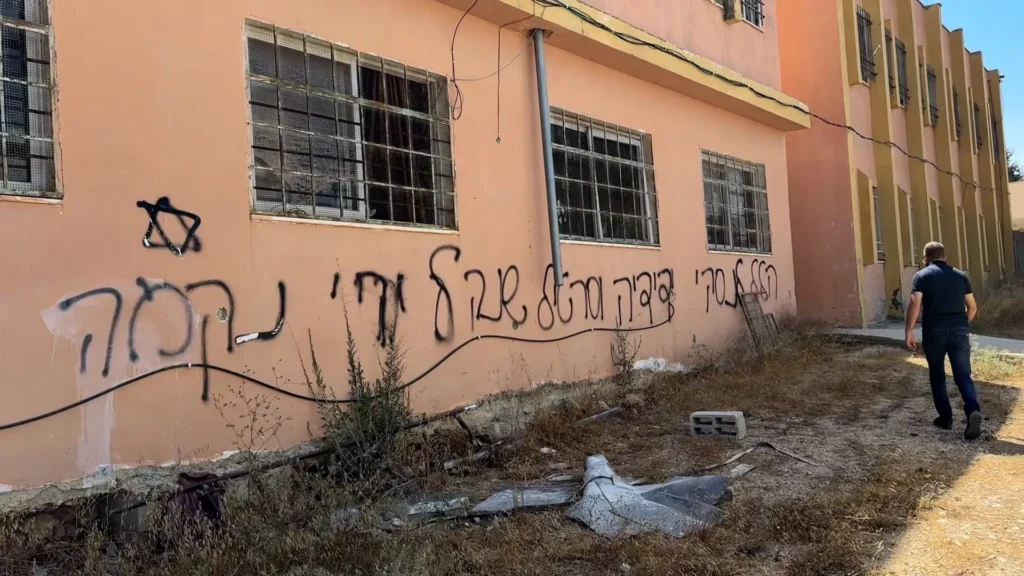
Racist and threatening graffiti left by Israeli settlers on homes, schools, and public buildings has become a recurring feature of attacks on Palestinian villages in the West Bank. Reporting from Jalud, located 27 kilometres south of Nablus, Al Jazeera documented slogans including 'revenge,' 'go home,' 'go to hell,' and 'get out of the village' painted on walls. Misbah al-Haj Muhammad, a resident of Jalud, told Al Jazeera that these slogans typically appear following settler raids and sometimes feature the names of settlers killed in previous incidents. He described this as a deliberate challenge to local residents, noting that the village school has been targeted multiple times with the intent of intimidating children into staying away. Raed al-Haj Muhammad, head of the Jalud village council, described the graffiti as 'racist and exclusionary.' He stated that threats of revenge appear in Palestinian villages following events affecting Jewish people elsewhere. 'When a soldier is killed in Gaza, they take revenge here and write the names of their dead on our walls,' he said. According to the council head, groups known as the 'Hilltop Youth,' who are based in the West Bank highlands, are among those responsible. Jalud has a population of fewer than 1,000 people, yet settler groups have established 13 settlements and outposts on approximately 23,000 dunams of the village's land. The village has experienced five major attacks since January, the most recent occurring on 4 August 2026, when settlers targeted a residential building, torched Palestinian vehicles, and left racist graffiti. Azzam Abu al-Adas, a researcher on Israeli affairs, told Al Jazeera that slogans such as 'death to Arabs' are not merely transient acts but reflect deep-seated ideologies. He noted that since the war in Gaza began on 7 October 2023, the concept of destroying or expelling Palestinians has become more mainstream in parts of Israeli society. Walid Habas, another researcher, stated that 'price tag' groups target the very presence of Palestinians and their connection to the land by burning homes, mosques, farms, and trees. He added that the graffiti serves as a 'mark of ownership' to other settlers and the Israeli public, asserting that the land belongs to only one people. Habas further explained that the use of symbols like the Star of David alongside the text acts as a 'sovereign signature' claiming control over the territory. He argued that the visibility of these slogans along roads indicates that the perpetrators feel confident they will not be punished, and that a lack of accountability increases the likelihood of further violence. Despite the threats, Raed al-Haj Muhammad stated that the attacks have failed to alter the demographic reality of Jalud. Residents immediately work to repair damage and remove the graffiti, viewing their continued presence in the area as a strategic choice.